Sunday, November 8, 2015

Tectonic Food

On Monday we reviewed for our science quiz on Tuesday. This quiz is on unit 4 which is about plate tectonics. As a class we reviewed for this quiz by playing a review game. The class split into two groups and each person from each side was given a series of questions to answer. If the person got the questions right then they were given the chance to shoot a nerf-gun at the white board that had targets on it with different numbers of points. This helped me review because from hearing the questions I knew which topics I needed to review for the quiz. One topic I needed to review is the occurrences of the mid-ocean ridge. It is a big topic so it is important that I understand it very well.

On Tuesday we took our science quiz. The quiz was easier than I thought it was going to be and I think I may have studied some material that wasn't even on the quiz. After studying I had a better understanding of what happened in the mid-ocean ridge and it also helped a lot with memorizing the vocab. After the quiz we finished our blogs and our only homework was our blog for that day. Overall I think I understood most of the material on the quiz and seeing my feedback will help me study for the test a lot better.

On Wednesday we reviewed questions with the website Kahoot. The questions varied from review from the quiz and questions from the next unit. I missed some of the questions from the next unit but got most of the review questions. After that we finished all the vocab for the whole unit which took up all of the class.  One word that you have heard before but most likely not in the context of science is compression. Compression is when rocks are forced together by external forces. Most of the vocab was new words I had never heard before but when going over notes tomorrow I will probably understand it more.

On Thursday we started a new lab. This lab helped reinforce some of the material we had reviewed in class. This involved cake icing, graham crackers, and fruit roll ups. The fruit roll ups represented oceanic crust because it was dense but also thin. The graham crackers represented the continental crust because it was thick but not dense. The icing represented the asthenospere because it is a thick semi-solid.  We demonstrated how the different crusts would react with each other in different situations. After the demonstrations we filled the data table in with drawings of what each one looked like and geologic features that would result from them.

On Friday we reviewed notes. one main question from this unit was how has plate tectonics affected evolution, ocean currents and global climate. We discussed this question and found that since Pangaea broke apart, species of animals were isolated from their original continents and had to adapt  to their new climate changes which led to biodiversity.  This also affects ocean currents because the plate movement disrupts heat currents. The heat changes in the atmosphere because volcanic eruption emit sulfur which decreases the harm of uv rays and can decrease the overall temperature. After notes we finished our lab questions about plate tectonics. This week I improved on my study habits but I still need to keep working hard.



Sunday, November 1, 2015

Continent Drift

On Monday we finished our Continental drift activity. We did this activity to learn about the Continental drift theory since we cannot really do a lab on the Continental drift. In this lab we learned about a scientist from the early 19th century named Alfred Wegener. During his lifetime he created the earliest reasoning of Pangaea and Continental drift. Although people in his lifetime thought he was crazy, we now regard him as a genius. Some of his reasoning behind this was that the continents fit together almost like a puzzle. This implies that the continents were formed together and some how moved away from each other. His evidence also came from the fact that there were fossils of plants and animals that lived in  tropical climates found in glaciers. He reasoned an idea for the large land land mass which is what we know as Pangaea.

On Tuesday we did yet another activity involving the Continental drift theory. In this lab were instructed to create a model of what Pangaea might have looked like. We first color coded each physical feature such as mountains and rivers. We then cut out each continent. Then like constructing a puzzle we fit the continents together by their land features and shapes that corresponded with each other. After it was all put together we could see how each continent's physical features and land edges matched up and created one super continent. Matching these up really helped show on a visual level how each continent connected. After doing this part of the lab I can see why Wegener had the theory that he did.

On Wednesday we finished this lab. The last activity we did on this lab was a model of the oceanic crust and the occurrences that happen there. We cut three slits in a paper and each slit represented an important feature in the oceanic crust. The center slit represented the mid-ocean ridge and the two outer slits represented subduction zones. Slips of paper slid in and out of the slits to represent magma. The paper coming from the mid-ocean ridge was magma coming up and hardening into crust. The paper coming out of the two subduction zones came out of the bottom and represented continental crust being recycled back into the mantle. This model helped me have a better understanding of what really happens in the oceanic crust because understanding this is something I need to improve on.

On Thursday we reviewed for our quiz by doing textbook questions and short answer practice questions. After doing the questions I now know that I need to review the layers of the earth. Specifically the parts of the mantle such as the asthenosphere and the mesosphere. The asthenosphere is review but the mesosphere is a new layer we are just learning about. After that I worked  on short answer questions. I wrote my answers in the comments section but I was not signed in, so my work did not save. I was sad that this happened but I got enough practice in for the quiz even though they were not submitted.


Sunday, October 25, 2015

New Unit

On Monday  we did not have school because it was a teacher workday.

On Tuesday we reviewed our test we took on Friday. I did very well and only missed one question. I definitely would not have missed it if i had read it carefully. This is definitely something I can improve on. Since we were starting a new quarter, we cleaned out our binders. After cleaning them out I then realized that I am going to have a lot of information to study for my midterm. We have also started a new unit on plate tectonics. This unit will have lots of vocab from the unit about the earth's core because that is what forms the earth's plates. After that we started a new science starter. Then we continued to work on our Eco-science lab. This was our last day of data collection and all of our plants had died. This was probably because there was a large decrease in temperature over the weekend. After eight days of growing we threw the plants in the garbage which in my opinion was not very eco-friendly.

On Wednesday we spent most of the class time working on our Eco-bottle lab. We worked on our conclusion and discussion questions. When writing any conclusion it is important to use your hypothesis and tell whether it was correct or  incorrect. From this week I need to improve on constructing a conclusion so I am glad this lab will give me lots of practice.

On Thursday we officially started to discuss unit 4. First we started out the unit by taking new note cards. One word that really stuck with me was magma. I had heard this word before but never really understood what it meant. In case you heard this word mentioned and did not know what it means, it is a lava like substance but instead of it being on top of the earth it lies below the volcano. We also went over some basic information about the earth's crust to get us ready for plate tectonics. One thing we had slightly covered in past units was the ocean crust and the continental crust. The continental is denser under mountains because of the pressure applied from the mountains. After starting notes we worked on finishing our Eco-bottle lab. Today we traded labs with other groups and evaluated other group's work. For the most part, our lab did not have many corrections just some technical errors that we can easily fix.

On Friday we finished the week with a cool activity. Okay it was not as cool as an explosion but it was better than a pop quiz or worksheet. We started the class by adding more note cards to our collection. The new vocab really helped me understand how the earth is made up and how the plates move. After vocab we reviewed our notes and learned how some early scientists reasoned how the continents move apart from each other each year. This theory is called continental drift. After notes we did an activity that we will finish on Monday. this activity was very hands on and allowed us to do some real thinking.

Overall this week has been great and went by a lot faster than I had anticipated.


Sunday, October 18, 2015

Dead Plants and a Test

     On Monday we took more data from our plants and our group was on day four of collecting data but the plants had been growing for much longer. Since we were not there to water the plants over the weekend the plants began to wilt. Also since they have been moved to the green house they did not grow as much. While each group was taking data we also reviewed notes. One thing I learned was some ways that carbon is returned to the atmosphere. One way is the burning of fossil fuels. Since humans are burning a lot more fossils, increased levels of carbon dioxide are occurring. One thing I can do to study for my test is review the discovery education question and notes.

     On Tuesday we reviewed in class by taking a survey of questions to see what we knew. This helped me a lot because it helped me know which note cards I need to review. Two words I often mix up are Convection and Conduction. I know from reviewing that convection is heat moving through a liquid. After that we started a new lab to help demonstrate the carbon cycle.  As a group we would have a total of eight tests and each group was assigned to do one question. The question our group had to answer was, "do plants do cellular respiration in the light?" My hypothesis is no, because plants need sunlight to perform photosynthesis so since they have sunlight they will have a way to make food. Our group set up our trials and then will wait until tomorrow to get our results. After that we learned how to set up a graph in spreadsheets to better and more neatly display our data. It was definitely a challenge but easy when we got the hang of it. After that we took the data for day 5 of our plants. Our plants still seem to be wilted but so did everyone else.

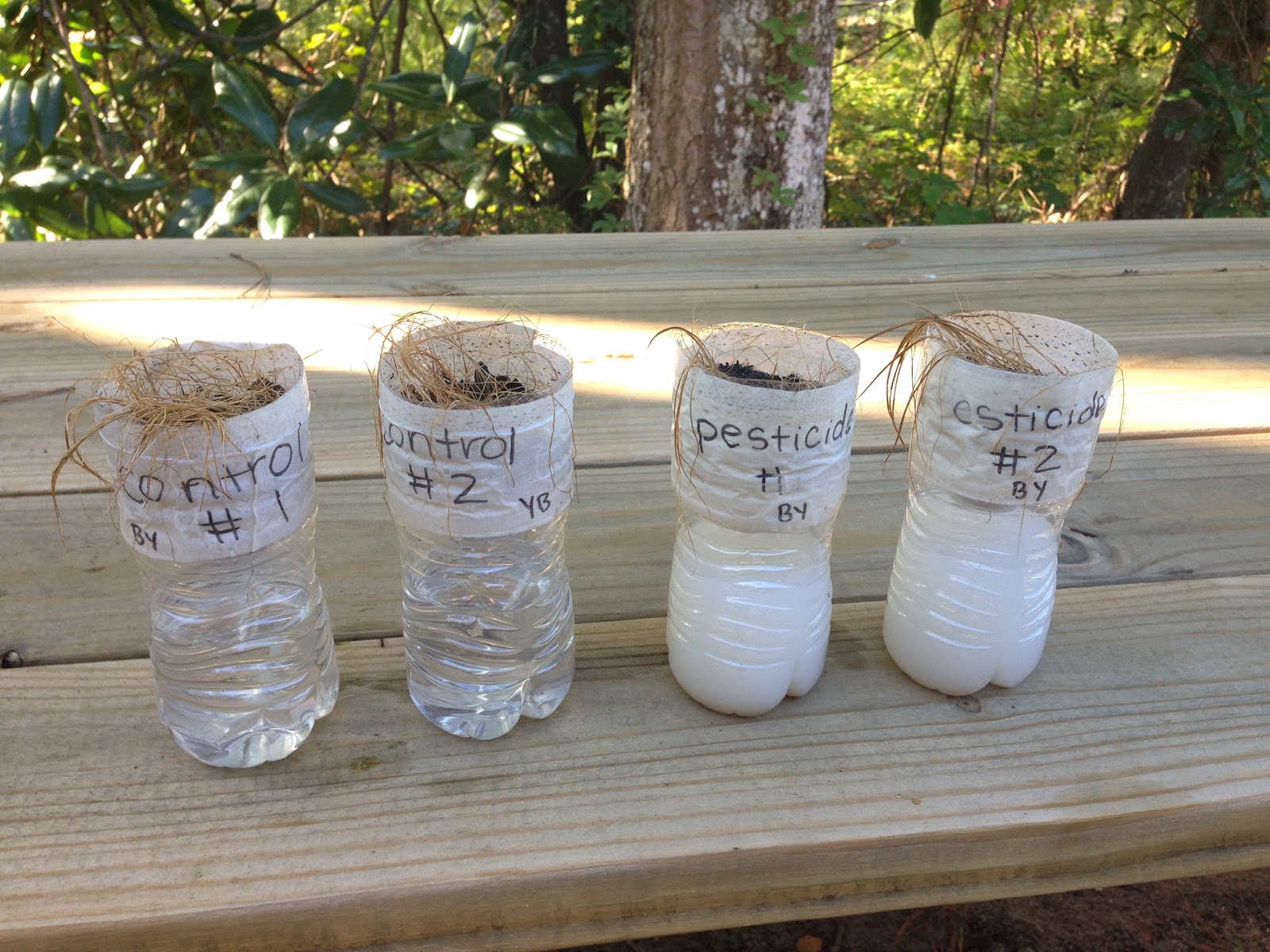
      On Wednesday we finished collecting data for our carbon cycle lab. In the is lab we found that when plants undergo cellular respiration they produce carbon and take in oxygen but when they undergo photosynthesis they produce oxygen but take in carbon. We know this because the indicator turned green when there was carbon but turned blue when there was oxygen. The plants in the light turned blue but the plants in the dark turned green. From this lab I learned  that plants are a main contributor to the carbon cycle. After that we finished setting up our graphs with our data for our plant data. We then took data for our plants for day 5. Our plants do not look as healthy as they did and the pesticide is making the water very cloudy in the bottom of our bottles. On Friday we will take our test and it will also be the last day of data we take.

On Thursday we took data from our plants on day 6. Most of our plants were dead except for one of our control plants. Although we have not completed all our data my prediction for our plants is that that they will just continue to die and wilt. I think this was their predetermined fate from the beginning.Along with taking plant data we also prepared for our test on Friday. We did this by reviewing our study guide in class. This really helped me a lot because the students who did their study guide had an opportunity to ask questions in class and go over notes. Overall one thing I can improve is studying. Using the discovery education questions is a great way but I definitely need to study the questions about the earth's axis.

On Friday we had our test. This test was a lot easier in my opinion than the quiz. I felt much more prepared for the test and was able to retain the information better when studying during the course of a week. I think quizzes are a lot harder than tests because there is less possible points so if you mess up then it affects your grade much more. After the test we also took plant data and my prediction was right, our plants are dead. I feel bad for this poor grass, I sure wouldn't want to be sprayed with chemicals and then get malnourished. Overall this week has been a busy one and I am glad it is over.


Sunday, October 4, 2015

New Unit

     On Monday in class we started a new unit on how humans have impacted the Earth over time. As humans we tend to consume more natural resources than we actually need to survive. Along with over population of the earth of a whopping 7 billion, our resources tend to deplete rather quickly. This new unit targets that problem and educates us on what our actions can really cause.

     To start the class,we did vocab cards on some of the new words in our vocab. One word that stuck with me was biomass. Biomass is dried matter that is compiled in a habitat or living area. An example of this is dried leaves. So instead of saying "I have to rake the leaves outside", you could say " I have to rake the biomass outside".

     After that we talked about our new lab. In this lab we will go over and learn how the things that we pollute the atmosphere with can affect the growth of our plants. This is the first lab so far this year in which we will actually construct our own labs. This project is very similar to the biosphere lab we did in sixth grade but this lab will take about 2 weeks.

     On Tuesday we finished up the note cards for the quiz we will take next Tuesday. One new word we added to our collection of note cards was hydroelectric energy. Hydroelectric energy is energy made by water sources such as dams. However this is one of the many "natural resources" that is questionable if it hurts or helps the environment. In our notes we began learning about the largest contributions to the gaping hole in the ozone layer. For those who were wondering what the ozone layer is, it is a layer in our atmosphere that protects our plant from some of the sun's harmful rays. I bet you never thought that one animal's fart could contribute to 20 percent of the earth's overall green house gas level. Cow farts contain methane which is natural green house gas but is still harmful to our atmosphere. I bet you will remember that next time you see a cow.

     After notes we got into groups and discussed and brainstormed for our sustainable ecosystems lab. In this lab our group will be testing to see the effects of pesticides on plants. We will have two control groups and two test groups to make sure our results are very accurate.

    On Wednesday I was sick so I could not attend science class. However it seems like they were very productive.

   On Thursday we continued with our lab. Since I was not there the previous day, my lab partner had to update me on what was happening.To finish up the main parts of the lab we created our lab procedure. Since we were testing the effects of pesticide on plants, we made sure to include the step on the amount of pesticide used and when to apply it. After writing the procedure we set up our bottles. To do this we took four water bottles,two for tests and two for control, and cut the tops of of them. Then we poked a hole in the top and put water on the bottom of the bottles. Then in the upper part a mixture of soil and Bermuda grass seeds.  To finish them off we added four sprays of water and let the magic of science kick in. One tip when doing any labs is to label each test or group so that you do not get anything mixed up.

    On Friday we continued with our labs.  Today was the day we created our data tables for the growth of our plants. When making our data table we made sure we included both qualitative and quantitative observations. A quantitative observation is an observation that deals with numbers but a qualitative is an observation that deals with descriptions and appearance. For example in our lab our first quantitative observation was the height of the grass and our first qualitative observation is that nothing has started to sprout in the soil yet.

I can improve on my speed for Picture This. I have a new strategy up my sleeve.


Sunday, September 13, 2015

Relative Dating


Monday was Labor Day so we did not have school.


 On Tuesday in science class we began reviewing for our quiz on Wednesday. We went over some new rock terms used in relative dating. Relative dating is when you classify rocks with no certain number but in chronological order like youngest to oldest. Also in addition to that, we did a worksheet focusing mainly on relative dating and on the back we added some new rock terms. The pictures we drew with the terms really helped me understand the main concepts and helped me study for my quiz the next day.


On Wednesday we had our quiz. I think I did okay but in my opinion some of the rock questions were worded weird. I studied for about an hour but one thing I could improve on is double checking the notes to get any information I might have missed. Along with the science quiz we had another science Olympiad meeting. I am super pumped for this year and am glad to be a part of the whole thing.


On Thursday we reviewed our quiz we took the day before. I did not do as well as I hoped but there is always room for improvement. Since we had a substitute we finished the note cards for unit two. Most of the note cards we added were words I was familiar with but had no idea what they meant. Before doing these note cards I had no idea that Pangaea was when the earth was one large supercontinent(also a vocab word) that began to break apart with a process called uniformitarianism . I now know from the quiz that Hutton came up with the term uniformitarianism not unconformity.


On Friday we reviewed our notes cards we did the previous day in class. After that we started section 5 of our notes. One thing I took back from the notes is the science words used by  professionals. I bet you didn't know that ga stands for giga annum which is a billion years. So instead of saying the earth is 4.6 billion years old you could say the earth is 4.6(ga) years old. One of the Latin roots you probably didn't know, unless you took Latin, is eon which means big. In science words an eon is the biggest division in the geologic time scale.

Overall this week has been a week of review and notes. Next week will be much shorter so we will not be blogging.One thing I can take back from this week is even if you do not do so well on an assignment you can always take something back from it.


Relative dating Lab


Relative dating graph


Monday, September 7, 2015

Fossils and Dating


On Monday we started the week by making three new note cards and starting the new vocab for unit 2. After that we reviewed the test we took on Friday. This test was only a review so future tests should be much harder because it is new material. We still had an Oreo lab to finish so we drew up our conclusions and proved our hypothesis to be wrong or right. Tomorrow we will start a new lab to learn new topics.

On Tuesday we did and intro into unit 2. The whole creation of the earth in one class period is a lot considering it was 13 billion years ago. We first started by adding 3 more cards that would help us understand some of the topics in the unit. After that we began to take notes and fill out an earth's crust diagram that looked like a pizza that was in the oven too long. We briefly talked about the first two layers which were the inner and outer layers of the earth's crust. After this lesson I happened to realize that we as humans have not been around for along time.

On Wednesday we continued with our notes and learning about the creation of the earth. We completed two more note cards to add to unit two of our vocab.Then we finished our diagram of the earth's layers. We are exposed to the earth's crust, the top layer, so we are naturally thinking it is one of the biggest layers but it really is not. The mantel is the largest and thickest layer making 70% of the the earth's volume. Even though there is so many movies about going to the center of the earth it is pretty much not likely that anyone has gone down there. First of all the inner core is 6000 kilometers down and approximately 12000 degrees Fahrenheit. Yeah, I don't think it is very possible. One of my favorite parts of the unit is learning about fossils. Fossils are made out of traces of past life that are preserved in rock in a process that can take hundreds of years.

On Thursday we continued with our notes on Unit two. This time we went deeper into fossils. After that we started a new lab on radiometric dating. Unlike relative dating, radiometric dating gives a more accurate age on fossils. When a rock sample has a radioactive element, it can be dated by how much of the parent isotope remains. In this lab we simulated the process radio metric dating with pennies. We had a hundred pennies and each penny represented an atom of the element carbon 14. We would then dump out all the pennies and the dump would be considered a half-life. We removed all the coins with tails to represent removing the dead atoms that are no longer radioactive. We then recorded the number of heads which were the parent isotopes. We continued this process several times until there was no more. We did three trials and all of our data was very close. In reality each half-life would take 5730 years and "ain't no body got time for that!". This lab was a good simulation in my opinion and helped me grasp the larger topic of radiometric dating.

On Friday we reviewed our notes for unit 2. One of the main things I took back from the unit was Superposition because it is such a fun word. Superposition states that sedimentary rock formations form so that the oldest layer is on the bottom and the youngest layer is on the top. This makes sense because over time more rock layer will be added. After reviewing notes we worked on our radiometric dating lab. We reviewed the data and determined how many years it would take for each half-life. One thing I can improve on this week is to double check my labs for spelling and small careless errors.